
a profile of Jennifer Yu by Bailey Lowe
My Favorite Activity was Lighting
an interview with Kylie Mohr by Bailey Lowe
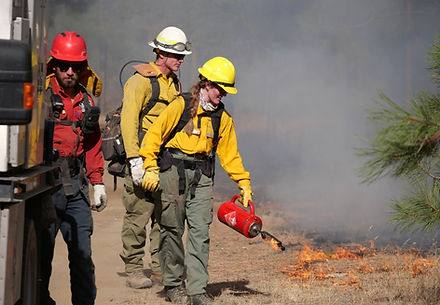
During the Artist-in-Fire Residency Program, environmental journalist Kylie Mohr participated in a Prescribed Fire Training Exchange (TREX) in the northeastern Washington wilderness where she spent two weeks burning sections of land to help prevent the negative effects of natural wildfires in the future.
This interview has been edited for length and clarity.
Tell me about yourself.
I'm currently a freelance environmental journalist and a correspondent for the magazine called High Country News, and my work really focuses on all things wildfire—everything from the health angle to the ecological angle to what rebuilding and recovery looks like, inequality in those things, and preparedness land management. In addition to wildfire, my work really focuses on wildlife, conservation, public lands, and wildlife and water in the west. These western environmental issues are really front and center in my work and often overlap, which is great. And in addition to High Country News, I publish for a lot of different publications. Some of the biggest titles that I've worked for are National Geographic and the Atlantic, and then a whole host of others—Grist, Vox, Business Insider. I just love getting western stories and environmental issues out to a regional and international audience.
What I do has taken me to some really cool places, in addition to getting to play firefighter/firelighter for a couple weeks this fall. I got to spend a night at the top of an old grove tree for an assignment with Sierra Magazine last year, which was really fun. It was crazy. I definitely learned I am terrified of heights and won't be doing that again. I've been to Alaska to report on snowy owls. I got a bunch of cool stuff in Montana and Glacier with some scientists studying pink snow and snow algae in the high alpine.
In my background before that, I got a Master’s at the University of Montana in their Environmental Science and Natural Resource Journalism program. I've got my undergrad from Georgetown. I used to live in Wyoming. I'm from Washington originally.
How did you learn about the Artist-in-Fire Residency Program and what made you want to do that?
I think I saw a posting for the Artist-in-Fire Residency on Instagram or X or some social media platform. I was instantly like, “ooh, what is this?” Because anytime I can do something that kind of is hands-on and grounds my work in actual lived experiences and being able to do something that not very many people have access to, I immediately was interested in that. I was reading the description, and I was just like, “wow, this this seems incredible and such a cool opportunity.”
I think one of the issues with prescribed fire is that it is so hard to get into as a civilian. You don't have the training or the gear or really anything to be a responsible participant. You can't really just show up to one of these things and be like, “hey, I want to help.” And so, even though it's something I read a lot about, I've never (before this fellowship) had the opportunity to actually participate in it and being a journalist, sure, we can go to things and observe, but there's something so different about actually doing alongside people rather than standing 20 feet behind with a notebook. So, the opportunity to do something like that just really jumped out at me, and because I'm a freelancer, one of the benefits of that is I have flexibility to go on a two-week prescribed burn and spend 40 hours over the course of a couple months taking the classes that we needed.
_HEIC.png)
What did you do to prepare and what were some of the things you learned in the training?
The online training was cool in the sense that I realized I knew more than I thought about fire behavior and firefighting techniques and things like that from my journalism and from my reporting background, so that was nice to see some of my professional knowledge actually integrating into this in a useful way. I participated in a lot of government webinars and things that were a little bit dry at times, but they did give me the basis to understand terminology, techniques, and the basics of the science of fire behaviors, so that I’m not wondering, “Oh, it's really windy today. Why aren't we lighting? Oh, because wind carries fire.” Or, “Oh, it's been really dry. It hasn't rained in a long time. Why aren't we lighting? Oh, okay, because relative humidity and the different fuel moistures matter when you're thinking about how to control a fire and keep it contained and not burning too hot and severe to ruin things rather than regenerate them.”
And then the physical training: I think I probably over prepared for that. I was really nervous about not being fit enough to do it, so I got a weighted vest and timed myself speedwalking around a track near my house with the weighted vest and hated that! But then the test was totally fine, so I think I might’ve overprepared for that a bit.
I'm in a cool position in that my fiancé was actually a wildland firefighter before we met, and so I was peppering him with so many questions of what to expect or what kind of gear I should buy.
That's the other thing, too, that was really helpful about this fellowship: we had the stipend to cover some of our time being spent on all of this, but also to pay for fire boots (because those are super expensive); you have to have certain certified types that go up high enough on your leg and have the right thickness to be fire resistant and all this stuff, and they can be three or four-hundred dollars if I remember correctly. That's a lot if you're not a firefighter and you're never going to wear these around town!
You borrow from your TREX all of the Nomex shirts and pants and a fire backpack that carries all your stuff and hard hat. You buy your own gloves, but gloves are cheap at hardware stores. A lot of the prep was not only “how is this all going to work?”, but also “what do I need to not be totally miserable or unsafe?”
During the Prescribed Fire Training Exchange (TREX), what was your onsite training and what did your day to day look like?
Before we started burning, we had a couple days of part classroom instruction and then also part field instructions. We went around to different stations and learned about all the different pieces on a water engine truck, and how you open and close the hose and nozzles and all this stuff, which it sounds really basic, but you don't necessarily know how to use it in the context of fire. I had this weird tool: I think it was called a combi—a combo tool that you have to screw and unscrew the head in different ways.
There were many very basic things that I don't know (as you work behind a computer), and I needed people to be constantly explaining everything to me. So, we did a lot of that kind of training, like “here's how to use a drip torch” and “here's all the steps to screw and unscrew the lid.” It’s just all of this very fine detail that if you're a firefighter, you don't even think about it, but can be confusing if you have never touched these tools in your life.
But I learned most by doing and by being a member of different groups. I remember the first day I was like, “wow, I feel really unqualified to be standing here near the fire because I don't totally get what's going on.” But you really do learn very quickly because you're so immersed and because the cool thing about TREX is there are a lot of people there with different skill levels. There are entry level novices as well as full-time firefighters and people that do prescribed burns for a living. You could learn a lot just by observing what they were doing and following orders. That's the other interesting thing about fire culture: it's very militaristic. It's very, “here's your squad leader” and “here's your captain” and “here are the roles you're going to play” and “here's the person that you answer to.” It's very hierarchical. So, to an extent, as long as you follow your little individual orders, then everything is fine—at least in your own little bubble. That was interesting to witness.

What was your favorite day/favorite activity?
My favorite activity was lighting. You definitely get an appreciation for how pyromaniacs exist! People in fire call it getting bit by the firebug, and I was definitely bit by the firebug. I mean, if you think about it in your daily life, you don't really have very many sanctioned opportunities to light things on fire, right? Like you're lighting a candlewick, you're maybe lighting a campfire, and that's pretty much it. But this is like, “here is a jug full of fuel” and “here's this whole area that you get to burn.” And you do it in a controlled way; there's a lot more to it than just throwing matches and being like, “okay, let's see what happens.” It's very controlled, very slow, very methodical, but also mesmerizing, fascinating, and very fun.
Lighting the fires was very challenging physically—the torch is really heavy. The little unit that I burned was on a hill, and so we were walking up and down and up and down and up and down, and you're wearing long sleeves and long pants, carrying a bunch of stuff. You have a bunch of things on your back. I was dripping in sweat. It was absolutely one of the hardest physical things I've ever done, and everyone else was just being really nonchalant about it.
My favorite day was the day that I got to light—I think it was a 14- or 15-acre area—with a bunch of other people, and in addition to just the enjoyment of lighting things on fire, it was also really cool to work in tandem as a team with other people. There were people lighting and there were people holding. There was someone who was overseeing all the lighters. Really being part of a team and also feeling like I was a contributing member of that team was awesome, and I feel that just speaks to the uniqueness of the fellowship and TREX in general. Being able to embed in that way and become part of this world temporarily (that is very much not part of my daily world outside of that) was cool. I felt so welcomed by people who were excited to teach and share their skills with someone who was just coming in bright eyed and bushy tailed.
How did your understanding of fire change throughout this experience?
I learned a couple of things. One, it really struck home to me what I already knew but didn't know quite so viscerally, which is that fighting fire and lighting fire is very hard work, and the people who do it are really putting their bodies on the line to do these things. Even just breathing in smoke from a couple days, I was like, “Wow, I report all the time on how smoke is killing people and how toxic it is, and here are people who are doing this all summer, all fall, all winter.” So that was, I wouldn't say eye opening to me because my eyes were already a bit open to it, but just realizing how tired I was after two weeks and then thinking about people who do this all summer and to a much more extreme extent gave me an even deeper respect for people that work in fire.
It also reinforced to me, quite frankly, how many hurdles there are to implement prescribed fire. The sheer amount of planning and checklists and resources and different agencies that were involved, just to do relatively small units on private land was eye opening to me in a way that I found a little depressing at first because I was like, “wow, how are we ever going to be able to scale up prescribed fire to the extent that we need when we are doing all of this for a total of, like, 30 acres?” And plans say that we need to burn millions more acres.
I raised that to a couple of people at the training to be like, “what is going on? How is this at all scalable?” And then I learned some of the complexities of burning on private land and how you have to be extra careful when there's a neighbor 20 feet that way. If you're on public land or reservation or just somewhere that has more land mass, you can be a bit more, “okay, we're going to burn this whole area, and it doesn't really matter if it goes a little bit more this way because there's not someone's house and livelihood on the other side of it.”
So, my understanding of fire—just the amount of work and human hands that are necessary to do these burns—hit home after all of this.
I also gained an appreciation and fascination for fire behavior. I learned about how to have the fire merge toward itself or how to draw a fire away or how to hold a fire in a certain area. It's crazy how you can light fire here, and you can light a bigger fire here, and the fire moves towards itself like a magnet. It's fascinating thinking about how fire goes uphill and downhill. It reminds me of a dance. That has been cool to reflect on.
Do you think that this experience will impact or has already impacted your writing?
Yeah, definitely. I've written two things specifically from this—the first was a story that was all about the prescribed fire labor force for Business Insider. That was a really awesome opportunity. If you live in the West, you might know about prescribed burns, and you might know why they're necessary, but if you live somewhere else in the country, or if you even live in the west, but you live in Seattle or Portland or something, prescribed burns are probably not really on your radar. The chance to promote awareness of ways to reduce wildfire risk such a huge, national audience was really awesome. I never know who may read that and what they may go do with it, but I'm optimistic that people read my article and maybe opened their mind a little bit, or became curious about what kind of stuff was going on in their state or in their county.
I also wrote an essay that's coming out in High Country News that is about my personal reflections on the experience and how it added a more nuanced take on fire for me as a wildfire journalist. I'm excited about this essay because it was really it was fun to write. I don't often write about myself, and that's always kind of scary as a journalist to say what you're thinking and feeling because we're trained not to do that in a lot of ways, so this was a really cool opportunity for me to reflect, write more creatively, and describe things in a more fun way.