Experience with Fire as a Writer:
Why It's Necessary to Go Outside
a profile of Jennifer Yu by Bailey Lowe
As a fiction author who likes to write about wilderness, nature, and the environment, second-year MFA student Jennifer Yu couldn’t pass up the opportunity to get out into the field and engage with these topics in a physical, embodied way. When she learned about the Artists-in-Fire Residency Program through the University of Idaho’s Confluence Lab, she knew she had to apply. Yu says, “I think it's really important, really helpful, really valuable, and perhaps even necessary, to go outside” to gain a more authentic experience of how humans actually engage with nature. Before moving to Idaho, Yu lived in Colorado and Los Angeles—places that that are especially impacted by fire—and the Artists-in-Fire Residency Program allowed her to get up close and personal with fire and experience it in an entirely new way.
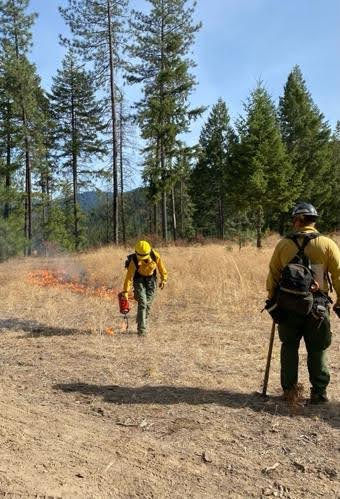
As part of the program, Yu spent two weeks in the northeastern Washington wilderness where she participated in a Prescribed Fire Training Exchange (TREX). For these exchanges, people who have varying levels of experience regarding fire (such as firefighters with different backgrounds or even fiction authors, as in Yu’s case) come together to learn about prescribed fire and participate in prescribed fire experiences where they use specialized equipment to safely burn multiple predetermined sections of land.
To prepare for the TREX, Yu and the other embedded artists first had to complete the Firefighter Type 2 certification (FFT2), which qualifies them to fight and prevent wildfires. This certification included 40 hours of online training as well as a pack test, which required the participants to complete a three mile walk while carrying a 45-pound pack in 45 minutes. Yu joked that the pack test was perhaps the most stressful part of this experience.
During the Training Exchange, which took place in late September to early October, Yu and the other TREX participants worked together to scout the area, plan and prepare to burn, burn numerous acres, and finally do “mop up,” which entails both ensuring that the fire is completely out and doing any necessary restorative work. Yu explained that before the exchange, the TREX organizers coordinated with private landowners and state and federal agencies to research, document, and plan which units are candidates for prescribed burns—immense prework goes into this process before any fires are lit. The TREX participants also had ample training on site with the equipment needed to burn the land. The first few days of the exchange involved physical training with equipment such as a drip torch, the different parts of a fire engine, hose lines, rakes, and portable water bladders.
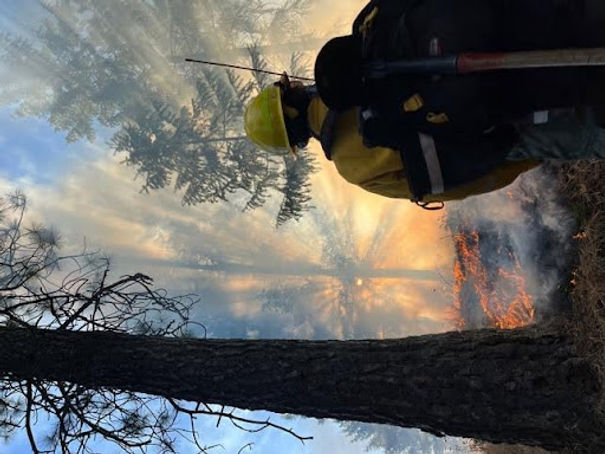
Throughout this experience, Yu learned to respect fire as not just a monolithic, destructive force, but as something that is beneficial to the ecosystem and the environment. She also learned that, if used properly, prescribed and controlled fire can reduce the likelihood of an out-of-control wildfire in the future. Yu also expressed how this concept is not at all a new realization; a few members of the TREX were from the Spokane tribe, and they have been doing preventative burning for generations. However, Yu explained that this healthy, symbiotic relationship with fire still must include deep respect, because fire is a powerful natural force that we cannot always control. Being near something so powerful gave Yu an emotionally intense experience, and she expressed that she felt almost a euphoria after burning land for hours at a time.
Yu also said that, as a writer, this experience “was at least as much about the people as it was about fire.” Because this group of people lived so closely for 12 days in high stress situations, they quickly developed a tight bond. One evening during the exchange, Yu had the opportunity to give a presentation to the team members about the role of fictionality in telling stories about fire. She explained how fictionality is a double-edged sword that can be used to create emotion and excitement in readers that directs them to focus on targeted topics, but also can cause generalizations and hyperbole, especially when discussing topics such as humans-vs-fire. Just as Yu learned to respect fire as an outsider, she was able to share her knowledge about storytelling with experienced firefighters. To end her presentation, Yu had her team members write their own short stories about fire. She had them draw words or phrases out of a hat that had to do with their TREX experience, such as “flame length” or “weather” or “burn,” and then had them use those words to construct a tale. She said that it was a really fun experience, and they all read the stories together.
Overall, this experience helped Yu as an author to expand her “aperture of thinking and writing” in a way that a classroom setting cannot. While academia is valuable for writers, Yu explained how sitting in a classroom all day is not necessarily synergistic with writing: “As a writer and as a grad student, it's so easy to just get totally consumed by your immediate day to day. There's a way in which sometimes it feels like my entire world is one square mile of the campus and everything I do is this one square mile and everyone I know are the people in this one square mile. And as a writer, that is bad, because you cannot conceptualize the world outside of yourself.” Yu is currently working on a novel about human relationships with climate and the environment, and the Artists-in-Fire Residency Program has helped her understand how fire behaves and has given her a real understanding of what it is like to be in such close proximity to such a powerful force. This hands-on research will influence her novel in a way that not all authors get to experience.