AIF crew 2024
Adam Huggins
Galiano Island, BC, Canada
Adam Huggins is an artist, podcaster, practitioner of ecological restoration, teacher, and naturalist living in the Salish Sea of southwestern British Columbia, on Galiano Island - the unceded lands and waters of Hul’qumi’num speaking people. As an environmental professional, he implements watershed-scale ecological restoration projects for the Galiano Conservancy Association and teaches a class in the Restoration of Natural Systems program at the University of Victoria. As a storyteller and musician, he produces and co-hosts the Future Ecologies podcast, which is currently wrapping up a 5th season of long-form audio pieces at the intersection of the human and more-than-human worlds.

Out of the Green, Into the Black:
A Journey into Cultural Fire
Adam Huggins
Cover art by Ale Silva for episode 6.9 of the Future Ecologies podcast
I stand on the edge of the narrow, one-lane road, staring down a steep, brush-filled slope. Harsh sunlight filters down through the canopy of Douglas-fir, arbutus, and black oak, illuminating a dense tangle of hazel, bay, and huckleberry in the understory. I’m already sweating under the weight of my pack in my borrowed NOMEX clothing, shifting back and forth trying to break in a very expensive and uncomfortable new pair of thick-soled leather boots.
“What’s your burn experience like?” asks the nearest crew member on the fire line.
“None” I say. “This is my first time.”
He nods and murmurs a polite response. I pause for a moment, adjusting my hardhat, and then venture,
“I am amazed at how steep this site is, and how much material is still on the ground.”
He grins. “Yeah, you’re like whoa, there’s a lot of fuels on the ground, and it’s steep.”
“That’s my impression,” I say, eyeing the precipitous slope with mounting trepidation and thinking, ‘are we actually going to attempt to burn this today?’
“Yep.” He laughs, a twinkle in his eye. “Welcome to the Klamath!”
CFMC Burn block for September 26, 2025, featuring thick underbrush on a very steep slope
- - -
This past September, I returned to the northwest corner of California for the first time in nearly a decade. I followed the Klamath River, liberated from the four dams that until recently blocked the passage of its once-famed salmon runs, from the arid steppe of southern Oregon down to the rugged coastal forests of Yurok territory. For three days, I would be a guest of the Yurok-led Cultural Fire Management Council, or CFMC (https://www.culturalfire.org/) as a representative of the Artists-In-Fire program, an artists residency created by the Confluence Lab at the University of Idaho (https://www.theconfluencelab.org/artists-in-fire-residency). Months of wading through the online classes and field exercises required to become a ‘Wildland Firefighter Type II’ had brought me at last to that one-lane road perched narrowly above the river below. My goal: take part in a cultural burn, and document the experience for the Future Ecologies podcast (https://www.futureecologies.net/listen/fe-6-9-on-fire-out-of-the-green-into-the-black). With a pulaski in one hand and a microphone in the other, I gathered my senses and steeled myself for the trial by fire to come.
- - -
A short distance away, the assembled crew of 30 awaits the lighting of the test fire. It’s an eclectic mix of Yurok elders, youth, and settlers, goofing around and relishing a bit of down time between the prep work and the burn itself. A hush falls over the group as Rick O’Rourke steps forward, holding a long bundle of aromatic silvery-green wormwood. We’re about to burn 2 acres of Rick’s family land. He lights the bundle and then brings it gently to the ground, igniting the dry oak leaves and fir needles that blanket the soil, murmuring a prayer:
“Creator, we’re here to put fire on the ground in a good way. Please look after all of our people who are here to do your service. Help them heal our land, heal our people, bring back our animals, create balance. It’s an honour.”
He takes a deep breath as the leaves begin to crackle and hiss, then turns around to face the crew.
“It’s receptive!”
A moment passes, and then one of the young Yurok crew members arches his back and lets loose a feral yelp. Soon, other members of the crew pitch in, releasing a chorus of fierce howls, guttural cries, and excited yips. As the collective catharsis comes to an end, we find our respective squad members and make our way down the seemingly near-vertical lines cut through the duff to give a boundary to the fire. The burn has begun.
Rick O’Rourke offers a prayer as he lights the test fire on his family’s land
- - -
I have been periodically interviewing people involved in prescribed fire since 2018, and have had a keen interest in the topic since at least 2013. That was the year I lived on the Klamath, just upriver in Karuk territory, and was first exposed to the practice by my neighbors on Butler Flat after nervously witnessing the Orleans Complex fire consume over 20,000 acres, including a chunk of the remote rural town I was living in. But none of these conversations and experiences prepared me for the exhilaration of actually participating in a prescribed burn myself.
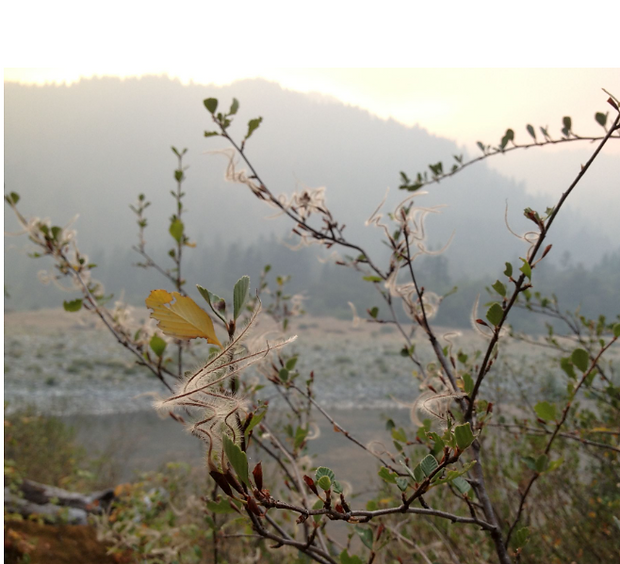
Smoke over the Klamath River from the Orleans Complex Fire in July of 2013
That first day, the fuels are indeed receptive. As the flames quickly spread, the crew kicks into action, manning water lines and drip torches. I’m forced to drop my microphone as a hose is shoved into my hand, and I’m immediately in the thick of it, spraying water on a “catface” at the base of a venerable black oak, preventing the fire from entering the wound and harming the tree. A sign of my inexperience, black smoke kicks back into my face, clogging all of my senses at once and instantly demonstrating why firefighters often say “eating smoke” instead of “breathing smoke.” I’m forced into a hasty retreat, and a helping hand steps in to take my hose. On this crew, there’s always a teammate ready to step in when you can’t take the heat.
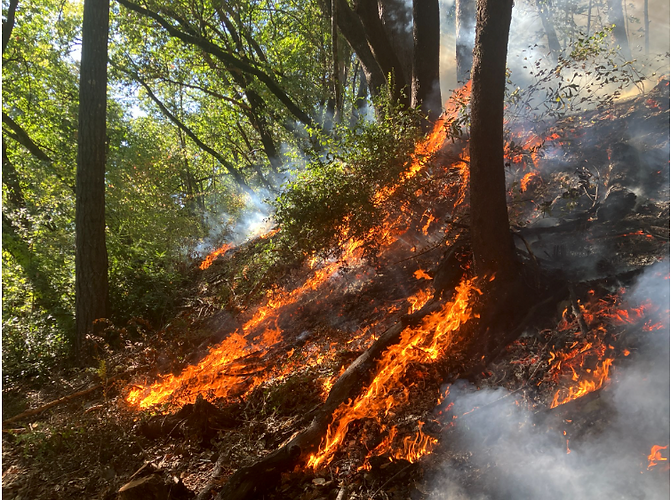
After a few hot minutes, the fire settles into a gentle backing burn, creepingly slowly downhill in graceful arcs. Members of the firing team shuffle back and forth just below the trail of flame, mostly watching with satisfaction as it burns merrily away. Occasionally, they offer encouragement in the form of small dots of incandescent fuel from their drip torches. Along the top and sides of the burn, members of the holding team make sure the fire stays within the boundary, immediately snuffing out the few embers that manage to float across the fire line. I watch the flames consume a kinky hazelnut shrub, the leaves slowly curling and the bark blistering under the low-intensity fire. After the burn, as we move through the ashy landscape to wet down any remaining hot spots, Rick will explain that the blistering tells him they generated just the right intensity of fire to ensure that the hazel will resprout with long, straight shoots - perfect for weaving the baskets that the Yurok people are famous for.
Beautiful, gentle backing fire consumes understory fuels but leaves trees unharmed
- - -
The reader may wonder, as I did, what distinguishes ‘cultural fire’ from ‘prescribed fire.’ In reality, they share many characteristics, but the key difference is that prescribed fire is typically applied by settler authorities and organizations to reduce fuel loads and achieve ecological objectives, while cultural fire is applied by Indigenous peoples to sustain a wide variety of cultural values, from improving habitat for game to restoring traditional oak prairies. Ideally, cultural fire and prescribed fire can be applied in concert at a landscape scale, allowing communities at the wildland-urban interface (or the ‘WUI’) to reduce the mounting risk of wildfires, improve the health and productivity of ecosystems, and uphold long-held cultural values.
On the second day, as we shepherd the fire through the understory of a black oak woodland, I corner Annelia Norris with my microphone. She’s a Yurok basketweaver, and as we sit underneath a hazel bush, hypnotized by the fire, she tells me,
“There are a lot more weavers coming along and coming up. And so there's a need for it, like we need to take care of our materials.”
In reality, it takes a healthy cultural landscape to produce a single basket. Vigorous hazelnut shoots are joined by spruce root, maidenhair fern, and even porcupine quills to create a wide variety of functional pieces of art, from the open-weave baskets that cradle Yurok babies to the watertight baskets used for leaching tannins from acorns. She continues,
“Our lands have seen trauma. Our people have seen trauma. So when you think about fire, it's cleansing, you know? It cleanses the land. And so when we're talking about healing this is very healing for us.”
Beaked hazelnut (Corylus cornuta californica); inset shows blistering of bark at base of plant
Later, I will speak with Yurok Elders who will reference the challenges that they and their ancestors faced through generations of fire suppression, when keeping traditional fire practices alive meant risking imprisonment or even death at the hands of agents of the Californian government. Today, their children are leading the way in restoring healing fire to their territory, and teaching anyone willing to lend a hand how to do so safely and effectively. Annelia concludes,
“We've normalized the cultural burning. Like, we've really taken leadership in asserting ourselves and our culture and our land management. You know, it just started catching fire.”
Annelia Norris stands on the fire line, separating the unburned ‘green’ from the ashy ‘black’
- - -
At the end of three days, we had applied cultural fire to over 30 acres - an impressive feat. We would burn through the night into the early hours of the morning, the flames and starlight merging into conflagrations of stunning beauty. On the morning I was scheduled to leave, as an early fall deluge quenched the landscape, I woke up completely exhausted, with blistered feet and chapped hands, wishing that there had been time for just one more burn. As Rick had told me the day before,
“Now you’re addicted and afflicted!”
As I returned to my home on Galiano Island in the Salish Sea of western Canada, I reflected on just how similar the ecosystems I work in as a professional biologist are to those I helped to burn in California. We too enjoy a dense green canopy of Douglas-fir, arbutus, and scattered oak, with an understory of huckleberries, blackberries, and the occasional hazel. Our community also faces unprecedented fuel loads and an elevated risk of wildfire due to generations of fire suppression and a spiralling climate crisis. This land shares a long evolutionary history with fire and a rich cultural legacy of Coast Salish peoples burning to maintain camas prairies, oak woodlands, and village sites. Why then, are the Yurok and Karuk restoring fire to thousands of acres of their territories, while we wring our hands with worry at each escalating wildfire season, “eating” smoke as a staple of our diet for months during the summer drought? Why had I needed to travel south of the border for the opportunity to take the first steps in my fire journey?
There are a variety of answers to these questions, manifesting as a series of cultural, ecological, and regulatory hurdles which must be approached to bring good fire back to small rural communities like mine. But my experience in Yurok territory showed me that these hurdles are not so high as they may seem. The CFMC started out 10 years ago as a volunteer effort by a rag-tag group of Knowledge Holders cobbling resources together, and now they’re a well-oiled professional unit employing dozens of community members. Over the winter, Joe Gilchrist of the Interior Salish Firekeepers made a tour of coastal British Columbia, stopping on Galiano Island to speak with me, my colleagues, and Indigenous community members. We stood together overlooking the Salish Sea, sharing stories and talking about bringing good fire home to the Salish Sea. Surveying the steep, brushy slope below, he looked at us and said,
“Oh yes. You could definitely burn this.”
After my time on the Klamath, I now knew it was possible. And I felt that, in good time, we would return fire to this place. As Annelia told me before I left,
“This is our purpose. This is why we're here, and this is what we need to be doing.”
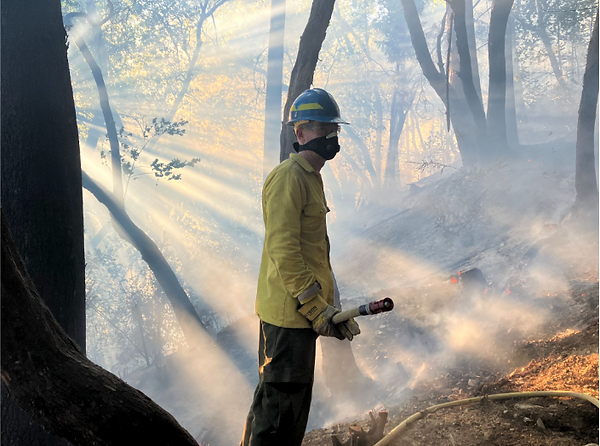
The author, helping to extinguish the last remaining embers after the fire passes through
QR Code for episode 6.9 of the Future Ecologies podcast